.svg)
International Donut Day 2026
🍩 Donut Let Anyone Tell You That Joy Doesn't Belong on Your Plate
By Dr Alanah Giles, Dietitian — Revive West End
It's International Donut Day, and yes — we absolutely celebrated at Revive with a very impressive tower of donuts. (Sprinkles included. No apologies.)
But beyond the sugar rush a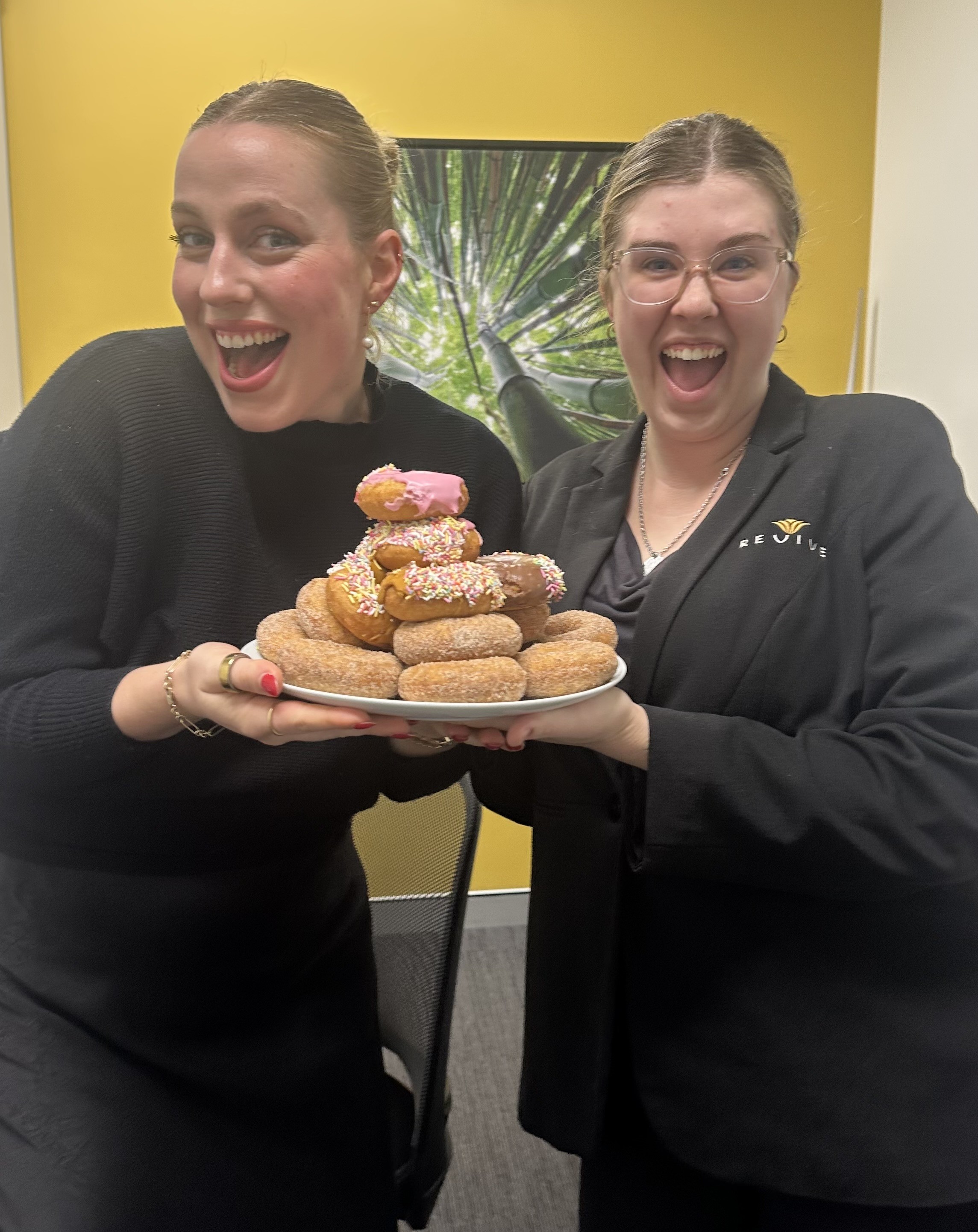 nd
the genuinely excellent photo we took, today felt like a perfect moment to talk about something I see in clinic more often than I'd like:
the guilt that follows eating something "naughty."
nd
the genuinely excellent photo we took, today felt like a perfect moment to talk about something I see in clinic more often than I'd like:
the guilt that follows eating something "naughty."
Because here's what most people don't realise — how you feel when you eat something matters just as much as what you eat.
Your nervous system doesn't care about your calorie count. It cares about your emotional state.
When you sit down to eat in a relaxed, positive headspace, your body does exactly what it's designed to do. Your parasympathetic nervous system — the "rest and digest" branch — kicks in, your digestive enzymes fire up properly, your gut motility is regulated, and your body efficiently absorbs and utilises what you've just eaten.
Now flip the switch. You eat the same meal — or in this case, the same donut — but this time it's accompanied by a running commentary of I shouldn't be eating this, I'll have to make up for this later, I have no willpower.
That internal monologue isn't just unpleasant. It's physiologically costly. Stress and guilt activate your sympathetic nervous system — your "fight or flight" response — which actively suppresses digestion. Cortisol rises. Gut function slows. And the irony? You're more likely to experience bloating, discomfort, and cravings afterwards — not because of the donut, but because of the story you told yourself while eating it.
One donut doesn't undo your health. One salad doesn't build it.
I say this to patients regularly, and I'll say it here: health is built over thousands of meals, weeks, and years — not destroyed in a single sitting. The occasional treat in an otherwise nourishing diet is not a problem. It is, in fact, completely normal eating.
What does create a problem over time is the restrict-guilt-binge cycle that kicks in when we treat food as a moral issue. When we decide that certain foods are "bad" — and that eating them makes us bad — we set ourselves up for a disordered relationship with eating that's far more damaging to long-term health than the food itself ever could be.
Intuitive eating isn't about eating whatever you want, whenever you want.
There's a misconception I want to clear up. Intuitive eating — the evidence-based approach that underpins a lot of my clinical practice — isn't a free-for-all. It's not "eat donuts every day and call it self-love."
It's about rebuilding trust with your body. Tuning into hunger and fullness cues. Removing the moral weight from food choices so you can make them clearly — not from a place of deprivation or guilt, but from a place of genuine self-care.
When you eat a donut on International Donut Day surrounded by your colleagues, laughing and celebrating, and you enjoy it fully — that is not a failure. That is a completely healthy, human, and honestly lovely thing to do.
So here's my clinical advice for today.
Eat the donut. Actually taste it. Be present for the experience. And then move on with your day — without the self-imposed sentence that follows so many people home after a treat.
Your health is not defined by a single food choice. It's shaped by your patterns, your relationship with food, your stress levels, your sleep, your movement, and — yes — the moments of joy you allow yourself to have along the way.
We work with this stuff in clinic all the time. If you've got a complicated relationship with food or you're ready to get some practical, non-judgmental support around nutrition and health — I'd love to chat.
Book in for a Dietitian consult at Revive. No guilt required. 🍩
Dr Alanah Giles is an Accredited Practising Dietitian at Revive Physiotherapy, Pilates & Massage, West End Brisbane. She works with patients on nutrition for chronic condition management, gut health, women's health, weight concerns, and building a healthier relationship with food.